
Last Updated: November 21, 2026
Quick Summary
Residential foundation repair services in NJ diagnose and fix cracks, bowing walls, and settling foundations using methods matched to the actual problem, such as injection, wall anchors, carbon fiber, or foundation piers. Homeowners should photograph warning signs early and get a written diagnosis before any work begins.
- Horizontal cracks in a block wall are serious because soil pressure is pushing the wall inward.
- Photograph and date every crack before patching, since patching hides evidence inspectors need.
- Crack injection for a single stable crack typically runs from the low hundreds to roughly $1,000.
- Foundation piers are the highest tier of repair, often reaching five figures for a whole-side lift.
- Verify a contractor’s New Jersey registration number with the Division of Consumer Affairs before signing.
Table of Contents
- Warning Signs Your Home Needs Foundation Repair
- How to Diagnose Foundation Problems Before Calling a Pro
- Foundation Repair Methods for Homes
- Residential Foundation Repair Services NJ Cost: What Drives the Price
- How Long Does Foundation Repair Take?
- Residential Foundation Repair Services NJ Reviews: How to Vet Contractors
- Schedule Your Foundation Inspection with Almark Construction
- Frequently Asked Questions
Warning Signs Your Home Needs Foundation Repair
Residential foundation repair services NJ homeowners call for usually start with a symptom they noticed months earlier and ignored. Foundation damage rarely appears overnight. It announces itself in small ways first: a hairline crack above a garage door, a door that suddenly sticks in July, a floor that feels springy underfoot. Catching those signals early is the difference between a targeted fix and a structural rebuild.
Homeowners who call at the first sign of a crack generally find the repair is simpler and less stressful than waiting for a bowing wall to develop.
Cracks, Bowing Walls, and Uneven Floors
A foundation crack is any visible break in a concrete wall, block wall, or slab, and not all of them mean trouble. Hairline shrinkage cracks are common in new concrete. What matters is direction, width, and movement.
- Vertical cracks often trace back to concrete curing or settlement and are frequently manageable.
- Diagonal cracks that widen at one end usually signal differential settlement, where one part of the foundation drops faster than another.
- Horizontal cracks in a block wall are the serious ones. They suggest soil pressure pushing the wall inward.
One more signal worth naming: cracks that reappear after patching. Cracks and settling can also point to sewer or water line problems in your yard, which are worth understanding before you call a pro. That pattern points to ongoing movement, not a cosmetic issue.
How to Diagnose Foundation Problems Before Calling a Pro
Homeowners can gather basic evidence about most foundation concerns with a few simple observations. The goal is not to diagnose the cause yourself. It is to gather enough evidence that a professional evaluation starts from facts instead of guesses.
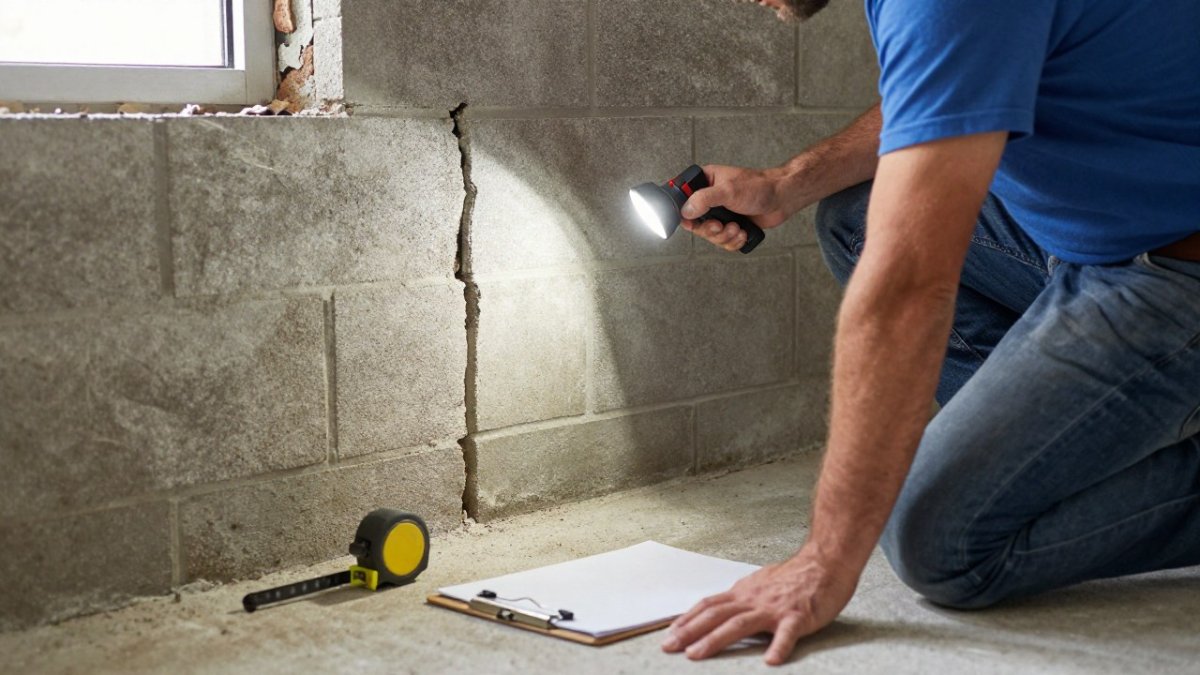
Here is a checklist homeowners can use:
- Walk the exterior perimeter and note every crack: location, direction, width (compare to a coin).
- Check that downspouts discharge at least 6 feet from the wall and that the ground slopes away from the house.
- Look for soil pulling away from the foundation or a visible gap at the sill.
- Inside, sight along walls for bowing and check for gaps at the top and bottom of basement walls.
- Test doors and windows on every floor. Sticking that changes with the season is a clue.
- Photograph and date everything. A crack that grows between photos tells a story a single look cannot.
Watch out: patching a crack before it is evaluated hides the evidence an inspector needs and can trap moisture behind the repair. Photograph first, patch later.
What most guides miss is the water question. Cracks and settling often trace back to how water moves around the house, which is why backfill and final grading after construction deserves a look whenever movement shows up near an addition, pool, or new build.
Foundation Repair Methods for Homes
Foundation repair methods fall into three families: stabilizing the soil beneath the home, restraining walls that are being pushed inward, and lifting settled sections back toward level. The right method depends on the problem and the soil. The table below summarizes common approaches homeowners can use to sanity-check any recommendation they receive.
| Problem | What Is Actually Happening | Methods That Fit | Methods That Do Not |
|---|---|---|---|
| Vertical or diagonal crack, no movement | Curing shrinkage or minor settlement that has stopped | Epoxy or polyurethane injection; monitoring | Piers or anchors sold as a precaution |
| Horizontal crack in a block wall | Lateral soil pressure pushing the wall inward | Wall anchors, carbon-fiber reinforcement, steel strapping, drainage correction | Injection alone, which hides the crack without resisting the force |
| Bowing or leaning wall | Lateral pressure plus possible loss of wall strength | Anchors, carbon fiber, or a combination; drainage first where water is the driver | Piers, which address settlement, not lateral load |
| Sinking or settling foundation | Soil beneath the footing is compressible or washing away | Foundation piers (helical or resistance), underpinning | Crack injection, which does nothing for the footing |
| Sagging or uneven floors | Settlement of supports or joists, sometimes water-related | Joist repair, support posts, piers where the footing is the cause | Cosmetic floor leveling without fixing the cause |
| Water intrusion with cracking | Hydrostatic pressure and poor drainage | Drainage correction, waterproofing, then structural repair as needed | Structural work alone, which rarely holds while water keeps moving |
Piers, Anchors, and Underpinning Explained
Underpinning is the general term for strengthening or deepening a foundation’s support. Two common approaches:
- Foundation piers are steel supports installed beneath a footing to reach stable soil. Piers are generally used to address sinking and settling foundations.
- Wall anchors are one approach used to address bowing or leaning walls caused by lateral soil pressure.
- Carbon fiber or steel strapping can stabilize a cracked wall where movement has stopped but strength is compromised. It restrains the wall; it does not straighten it.
The distinction matters because a homeowner quoted for a method that does not address the actual force may be buying the wrong repair. Homeowners should ask any contractor to explain which force is moving the wall and why the proposed method counters it.
Where drainage is the root cause, structural work alone rarely holds. Excavation and drainage correction often come first, which is where excavation and drainage work on Long Branch and North Shore lots enters the conversation.
Watch out: a contractor who recommends the same method for every job is not diagnosing. The method should follow the problem, and the proposal should say so in writing.
Residential Foundation Repair Services NJ Cost: What Drives the Price
Pricing depends on the scope of each project, including the repair method, access, soil conditions, and permits. For current pricing or a quote for your project, visit the Almark Construction website.
General factors that affect the cost of foundation work include:
- Linear footage affected. A single crack is a small job. A 40-foot bowing wall is not. Most pricing scales with the length of wall or footing involved, so measure before you call.
- Repair method. Crack injection, wall anchors, carbon-fiber reinforcement, and foundation piers carry very different material and labor profiles. Injection is the least invasive; piers are the most.
- Access and excavation. Tight lots, finished basements, decks, and landscaping all add labor. A job that requires hand-digging near utilities costs more than one a machine can reach.
- Soil conditions. Sandy coastal soils behave differently than the clay-heavy ground found inland, and the depth needed to reach stable bearing soil changes the pier count and length.
- Permits and engineering. Some repairs require a structural engineer’s assessment and municipal permits, which add cost but also protect you and the resale value of the home.
- Restoration. Patching interior finishes, regrading, and replacing landscaping are frequently excluded from a low bid and added later.
Qualified ranges, not promises. Most practitioners find that crack injection for a single stable crack runs in the low hundreds to roughly $1,000 depending on length and access. Wall anchor systems for a bowing wall commonly land in the several-thousand-dollar range per wall, scaling with the number of anchors.
A written proposal should separate:
- Diagnosis and engineering, site visit, any structural engineer review, and the written scope.
- Materials and method, pier type and count, anchor count, or injection ports, named specifically.
- Labor and access, excavation, utility locating, and interior protection.
- Permits, pulled by whom and listed as a line item.
- Restoration, grading, patching, and landscaping return.
- Warranty, what is covered, for how long, and whether it transfers if the company is sold.
Watch out: a bid that is dramatically lower than others may reflect a missing line item, such as engineering, permits, or restoration. Homeowners should compare proposals line by line.
How Long Does Foundation Repair Take?
Timelines vary by project. Scheduling, permits, engineering review, and material lead times often extend the full calendar beyond the active work. The work itself is often fast. The scheduling, permits, engineering review, and material lead times are what stretch the calendar.
A rough sequence:
| Phase | Typical Duration | What Happens |
|---|---|---|
| Inspection and proposal | 1-2 weeks | Site visit, diagnosis, written scope |
| Engineering and permits | 2-6 weeks | Structural review, municipal approval where required |
| Active repair work | 1-5 days | Piers, anchors, or injection installed |
| Backfill and restoration | 1-2 weeks | Grading, patching, landscaping returned |
| Monitoring | 6-12 months | Checking for renewed movement |
Ask any contractor for a schedule with those phases named separately. A single “two weeks” promise that ignores permitting is a red flag.
Residential Foundation Repair Services NJ Reviews: How to Vet Contractors
Reviews are a starting point, never the whole case. A five-star average tells you people were happy. It does not tell you whether the repair held three winters later.
Our vetting sequence, in order:
- Verify the license and registration. Confirm that any contractor holds the required New Jersey registration. Verify the number, not just the logo on the truck.
- Ask for the diagnosis in writing. A contractor who cannot explain the cause in plain language is selling, not diagnosing.
- Request two local references from jobs at least two years old, and call them.
- Compare proposals line by line, not bottom line to bottom line.
- Confirm what the warranty covers and who honors it if the company is sold or closes.
For a deeper checklist on spotting unreliable outfits, see the signs of unreliable construction contractors. When excavation is part of the scope, the questions to ask before hiring an excavation contractor cover licensing, contracts, and who runs the machine.
The New Jersey Division of Consumer Affairs home improvement contractor registration is the authoritative place to confirm a contractor’s standing before you sign anything.
Keep in mind that the best-reviewed contractor is not always the best fit, since reviews often reflect communication and cleanliness as much as structural results.
Schedule Your Foundation Inspection with Almark Construction
Foundation problems reward early action and punish delay. The crack that is a cheap injection today can become a wall replacement in two years, and the difference is entirely about timing.
If you have spotted any of the warning signs in this guide, the next step is a professional look, not another patch.
Get started with Almark Construction and schedule an inspection that gives you a clear diagnosis and a written plan before any work begins.
Cracks and settling rarely fix themselves, and the cost of waiting compounds.
Frequently Asked Questions
What are the signs that a house needs foundation repair?
Look for stair-step cracks in brick or block, horizontal cracks in basement walls, doors and windows that stick, uneven or sloping floors, and gaps around exterior window frames. Bowing or leaning walls and water seeping through foundation walls also point to structural movement. Any crack wider than a quarter inch, or one that has grown over a few months, deserves a professional evaluation before you finish a basement or plan other renovations.
How long does residential foundation repair take?
Timelines vary by project and method. Engineering review, permits, and material lead times can extend the schedule before work begins. Ask your contractor for a written schedule that separates prep time from on-site days.
Will insurance pay for foundation repair?
Homeowners insurance usually covers sudden, accidental damage such as a burst pipe washing out soil under a slab, but it typically excludes long-term settling, earth movement, and poor drainage. Review your policy’s exclusions and ask your adjuster to confirm in writing. A structural evaluation from a licensed foundation contractor can document the cause, which helps support a claim or shows why coverage does not apply.
How do I choose a foundation repair contractor?
Request a written structural evaluation that names the cause and the recommended method, not just a price. Verify any New Jersey contractor’s license and insurance, ask for recent references, and compare at least two proposals line by line. Look for a workmanship warranty in writing, a clear payment schedule, and a plan for change orders. Read reviews for patterns in communication and follow-through, not just star ratings.
